


High Altitude Halacha: Prayer Above the Clouds
הרב שי טחןכג תמוז, תשפו08/07/2026As people preparing to leave town for vacation, this is a good opportunity to review some of the halachot relevant to praying on air travel
תגיות:תפילהטיסהחופשה
A. Praying in the Airplane Aisles
One should not organize a minyan in the aisles of an airplane if it interferes with other passengers. Likewise, an individual should not stand and pray in the aisle when doing so obstructs those who need to pass.
Rav Elyashiv (cited in Vayishma Moshe, p. 31) was asked about passengers who organize a minyan in the aisle of an airplane while other passengers complain that it prevents them from moving about freely, such as when they need to access the restroom. He ruled that since all passengers have equal rights to use the aisles, a minyan should not be conducted there, even if only one passenger objects.
Similarly, Rabbi Shmuel Vosner (Shevet HaLevi 11:25) ruled that one should recite the portions of the prayer service while seated in his assigned seat and stand for the Amidah only near his seat, provided that he does not interfere with other passengers. If even that is not possible, it is preferable to recite the Amidah while seated. This approach also helps maintain proper concentration during prayer and avoids issues of modesty and inconvenience.
Rabbi S. Z. Auerbach (Halichot Shlomo, Tefillah 8:2) likewise wrote that a person traveling by plane should recite the Amidah while seated in his place rather than in the aisles, since standing there obstructs the passage of others. Rabbi Moshe Feinstein (Igrot Moshe 4:20) also permitted praying while seated when standing would be difficult or would distract a person from proper concentration.
In Belechtecha Baderech (p. 34), it is recorded that Rabbi Yochanan Chayot, the rabbi of El Al, asked Rabbi Vosner about a donor who wished to provide a small Torah scroll and ark for use during flights so that passengers could conduct Torah readings and organized prayer services. Rabbi Vosner responded that this should not be done, as one should not organize minyanim during flights.
The Yalkut Yosef (Tefillah 90:69, note 35) records a practical example from Rabbi Ovadia Yosef himself. According to his testimony, Rabbi Ovadia declined to join a minyan that had been organized on an airplane.
B. Praying Near the Airplane Restrooms
One should not pray near the airplane restrooms. This is due to three concerns: unpleasant odors, obstruction of passenger traffic, and issues of modesty.
First, restrooms often emit unpleasant odors, especially when the door is opened. Since halacha requires prayer to be recited in a respectful and clean environment, one should avoid praying in close proximity to the lavatories.
Second, the area near the restrooms is one of the busiest sections of the aircraft. Standing there to pray may block access for passengers who need to use the facilities. As noted earlier, one may not obstruct the aisles or interfere with the movement of other passengers, and this concern is particularly acute near the restrooms.
Finally, there is also an issue of modesty. Throughout the flight, passengers—both men and women—frequently enter and exit the restroom area. Praying in such a location may lead to distractions and is not conducive to the proper dignity and concentration required for prayer.
For all of these reasons, one should avoid praying near the airplane restrooms and instead pray in or near his seat whenever possible.
C. Determining Prayer Times While Flying
The times for prayer while traveling by airplane are determined according to the location directly beneath the aircraft at that moment. If one does not know his precise location, he may rely on the sunrise and sunset visible through the airplane window. Nevertheless, it is preferable to wait until daylight has reached the ground as well.
Rabbi Moshe Feinstein (Igrot Moshe, 3:96) writes that a traveler flying through the night should consider daybreak to begin as soon as daylight appears in his location. Conversely, if daylight is delayed, the day does not begin for him until it becomes light. Rabbi Feinstein further explains that the usual calculations of three hours for Keriat Shema and four hours for Shacharit are difficult to apply during flight, since the aircraft's location changes rapidly. Therefore, he recommends praying as soon as sunrise occurs.
Rabbi Elyashiv (cited in Shvut Yitzchak, Purim, p. 12) similarly maintained that a passenger on an airplane is obligated in all time-dependent mitzvot according to the location beneath the aircraft. Thus, the times for Keriat Shema, prayer, and other mitzvot are determined by the place over which the plane is flying.
D. Praying from a Siddur vs. an Electronic Device
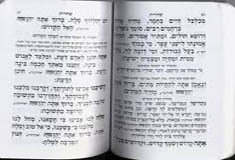
One should make an effort to pray from a siddur rather than from an electronic device such as a smartphone or tablet. However, if one forgot to bring a siddur, he may pray using an electronic device. If possible, he should place the device in airplane mode or disable notifications to prevent interruptions, and ideally have only the prayer text displayed.
There are several concerns associated with praying from an electronic device:
1. Distraction Due to Holding the Device
The Gemara (Berachot 23b) teaches that a person should not hold tefillin in his hand or a Sefer Torah in his arm while praying. Rashi explains that he may become distracted out of concern that the item could fall, thereby impairing his concentration.
According to Rashi, the concern applies specifically to valuable items that cause anxiety if dropped. Other authorities, cited by Rabbeinu Yonah, maintain that one should not hold any object during prayer, and the examples given by the Gemara are merely illustrative.
The Shulchan Aruch (96) rules in accordance with Rashi:
"When one prays, he should not hold tefillin, a sacred book, a bowl full of liquid, a knife, money, or a loaf of bread, because his mind is preoccupied lest they fall and his concentration be disturbed."
This concern applies not only to the Amidah but also to Keriat Shema and Pesukei DeZimrah, during which one is likewise expected to maintain concentration.
Praying from a smartphone would seem comparable to holding a siddur. The Shulchan Aruch (96:2) explicitly permits holding a siddur during prayer, since it is being used for the prayer itself and therefore does not create distraction. By the same reasoning, an electronic device used solely as a siddur would appear to be permissible.
2. Incoming Calls and Notifications
A second concern is that incoming calls, text messages, emails, or notifications may interrupt one's concentration. For this reason, it is advisable to place the device in airplane mode or otherwise disable notifications before beginning to pray.
Nevertheless, when necessary—such as while traveling, in an airport, hotel, or other location where a siddur is unavailable—it would appear permissible to pray from an electronic device. The prohibition against holding objects during prayer applies primarily as a preferred practice (lechatchilah); one who prayed while holding such an item has nevertheless fulfilled his obligation.
3. Marit Ayin (Appearance to Others)
A further concern is marit ayin. An observer who sees someone looking at a phone during prayer may assume that he is checking messages or otherwise using the device for non-prayer purposes.
Even so, when no siddur is available, it may be permitted. In such circumstances, using the device for prayer is justified, and the need to pray properly outweighs concerns about how the situation may appear to others.
E. When the Crew Instructs Passengers to Sit Down
If a person is in the middle of praying and the flight crew instructs passengers to return to their seats and fasten their seatbelts, or if the seatbelt warning light is activated, he must immediately comply and continue his prayer while seated.
The instructions of the flight crew are given for the safety of all passengers and must be followed. Therefore, even if one is in the midst of the Amidah, he should return to his seat, fasten his seatbelt, and continue praying while seated rather than remain standing in violation of the crew's directions (Shevet HaLevi 11:25).
F. One Who Feels Uncomfortable Wearing Tefillin on a Flight
A person traveling on a flight surrounded by non-Jewish passengers who feels uncomfortable wearing tefillin during Keriat Shema and prayer may pray without them and put them on after landing.
Although the Shulchan Aruch (25:4) rules that one should wear tefillin during Keriat Shema and prayer, lest he appear to be testifying falsely when reciting the verses that mention tefillin, this requirement is not absolute in all circumstances.
The Mishnah Berurah (25:14) explains that this criticism applies primarily to someone who deliberately delays putting on tefillin out of laziness. However, when a person is unable to wear tefillin due to circumstances beyond his control—such as difficult travel conditions, severe cold, or similar impediments—he should not postpone Keriat Shema until tefillin become available.
From this we learn that if a person feels extremely uncomfortable wearing tefillin on an airplane, it is preferable for him to recite Keriat Shema and pray without them rather than miss the proper time for prayer. After landing, he should put on tefillin and recite the appropriate passages.
This is especially true where there is a concern for personal safety, such as traveling through areas where there may be hostility toward Jews or where openly displaying tefillin could expose a person to harassment or danger. In such situations, one should certainly refrain from wearing tefillin until it is safe to do so.
One should not organize a minyan in the aisles of an airplane if it interferes with other passengers. Likewise, an individual should not stand and pray in the aisle when doing so obstructs those who need to pass.
Rav Elyashiv (cited in Vayishma Moshe, p. 31) was asked about passengers who organize a minyan in the aisle of an airplane while other passengers complain that it prevents them from moving about freely, such as when they need to access the restroom. He ruled that since all passengers
Similarly, Rabbi Shmuel Vosner (Shevet HaLevi 11:25) ruled that one should recite the portions of the prayer service while seated in his assigned seat and stand for the Amidah only near his seat, provided that he does not interfere with other passengers. If even that is not possible, it is preferable to recite the Amidah while seated. This approach also helps maintain proper concentration during prayer and avoids issues of modesty and inconvenience.
Rabbi S. Z. Auerbach (Halichot Shlomo, Tefillah 8:2) likewise wrote that a person traveling by plane should recite the Amidah while seated in his place rather than in the aisles, since standing there obstructs the passage of others. Rabbi Moshe Feinstein (Igrot Moshe 4:20) also permitted praying while seated when standing would be difficult or would distract a person from proper concentration.
In Belechtecha Baderech (p. 34), it is recorded that Rabbi Yochanan Chayot, the rabbi of El Al, asked Rabbi Vosner about a donor who wished to provide a small Torah scroll and ark for use during flights so that passengers could conduct Torah readings and organized prayer services. Rabbi Vosner responded that this should not be done, as one should not organize minyanim during flights.
The Yalkut Yosef (Tefillah 90:69, note 35) records a practical example from Rabbi Ovadia Yosef himself. According to his testimony, Rabbi Ovadia declined to join a minyan that had been organized on an airplane.
B. Praying Near the Airplane Restrooms
One should not pray near the airplane restrooms. This is due to three concerns: unpleasant odors, obstruction of passenger traffic, and issues of modesty.
First, restrooms often emit unpleasant odors, especially when the door is opened. Since halacha requires prayer to be recited in a respectful and clean environment, one should avoid praying in close proximity to the lavatories.
Second, the area near the restrooms is one of the busiest sections of the aircraft. Standing there to pray may block access for passengers who need to use the facilities. As noted earlier, one may not obstruct the aisles or interfere with the movement of other passengers, and this concern is particularly acute near the restrooms.
Finally, there is also an issue of modesty. Throughout the flight, passengers—both men and women—frequently enter and exit the restroom area. Praying in such a location may lead to distractions and is not conducive to the proper dignity and concentration required for prayer.
For all of these reasons, one should avoid praying near the airplane restrooms and instead pray in or near his seat whenever possible.
C. Determining Prayer Times While Flying
The times for prayer while traveling by airplane are determined according to the location directly beneath the aircraft at that moment. If one does not know his precise location, he may rely on the sunrise and sunset visible through the airplane window. Nevertheless, it is preferable to wait until daylight has reached the ground as well.
Rabbi Moshe Feinstein (Igrot Moshe, 3:96) writes that a traveler flying through the night should consider daybreak to begin as soon as daylight appears in his location. Conversely, if daylight is delayed, the day does not begin for him until it becomes light. Rabbi Feinstein further explains that the usual calculations of three hours for Keriat Shema and four hours for Shacharit are difficult to apply during flight, since the aircraft's location changes rapidly. Therefore, he recommends praying as soon as sunrise occurs.
Rabbi Elyashiv (cited in Shvut Yitzchak, Purim, p. 12) similarly maintained that a passenger on an airplane is obligated in all time-dependent mitzvot according to the location beneath the aircraft. Thus, the times for Keriat Shema, prayer, and other mitzvot are determined by the place over which the plane is flying.
D. Praying from a Siddur vs. an Electronic Device
One should make an effort to pray from a siddur rather than from an electronic device such as a smartphone or tablet. However, if one forgot to bring a siddur, he may pray using an electronic device. If possible, he should place the device in airplane mode or disable notifications to prevent interruptions, and ideally have only the prayer text displayed.
There are several concerns associated with praying from an electronic device:
1. Distraction Due to Holding the Device
The Gemara (Berachot 23b) teaches that a person should not hold tefillin in his hand or a Sefer Torah in his arm while praying. Rashi explains that he may become distracted out of concern that the item could fall, thereby impairing his concentration.
According to Rashi, the concern applies specifically to valuable items that cause anxiety if dropped. Other authorities, cited by Rabbeinu Yonah, maintain that one should not hold any object during prayer, and the examples given by the Gemara are merely illustrative.
The Shulchan Aruch (96) rules in accordance with Rashi:
"When one prays, he should not hold tefillin, a sacred book, a bowl full of liquid, a knife, money, or a loaf of bread, because his mind is preoccupied lest they fall and his concentration be disturbed."
This concern applies not only to the Amidah but also to Keriat Shema and Pesukei DeZimrah, during which one is likewise expected to maintain concentration.
Praying from a smartphone would seem comparable to holding a siddur. The Shulchan Aruch (96:2) explicitly permits holding a siddur during prayer, since it is being used for the prayer itself and therefore does not create distraction. By the same reasoning, an electronic device used solely as a siddur would appear to be permissible.
2. Incoming Calls and Notifications
A second concern is that incoming calls, text messages, emails, or notifications may interrupt one's concentration. For this reason, it is advisable to place the device in airplane mode or otherwise disable notifications before beginning to pray.
Nevertheless, when necessary—such as while traveling, in an airport, hotel, or other location where a siddur is unavailable—it would appear permissible to pray from an electronic device. The prohibition against holding objects during prayer applies primarily as a preferred practice (lechatchilah); one who prayed while holding such an item has nevertheless fulfilled his obligation.
3. Marit Ayin (Appearance to Others)
A further concern is marit ayin. An observer who sees someone looking at a phone during prayer may assume that he is checking messages or otherwise using the device for non-prayer purposes.
Even so, when no siddur is available, it may be permitted. In such circumstances, using the device for prayer is justified, and the need to pray properly outweighs concerns about how the situation may appear to others.
E. When the Crew Instructs Passengers to Sit Down
If a person is in the middle of praying and the flight crew instructs passengers to return to their seats and fasten their seatbelts, or if the seatbelt warning light is activated, he must immediately comply and continue his prayer while seated.
The instructions of the flight crew are given for the safety of all passengers and must be followed. Therefore, even if one is in the midst of the Amidah, he should return to his seat, fasten his seatbelt, and continue praying while seated rather than remain standing in violation of the crew's directions (Shevet HaLevi 11:25).
F. One Who Feels Uncomfortable Wearing Tefillin on a Flight
A person traveling on a flight surrounded by non-Jewish passengers who feels uncomfortable wearing tefillin during Keriat Shema and prayer may pray without them and put them on after landing.
Although the Shulchan Aruch (25:4) rules that one should wear tefillin during Keriat Shema and prayer, lest he appear to be testifying falsely when reciting the verses that mention tefillin, this requirement is not absolute in all circumstances.
The Mishnah Berurah (25:14) explains that this criticism applies primarily to someone who deliberately delays putting on tefillin out of laziness. However, when a person is unable to wear tefillin due to circumstances beyond his control—such as difficult travel conditions, severe cold, or similar impediments—he should not postpone Keriat Shema until tefillin become available.
From this we learn that if a person feels extremely uncomfortable wearing tefillin on an airplane, it is preferable for him to recite Keriat Shema and pray without them rather than miss the proper time for prayer. After landing, he should put on tefillin and recite the appropriate passages.
This is especially true where there is a concern for personal safety, such as traveling through areas where there may be hostility toward Jews or where openly displaying tefillin could expose a person to harassment or danger. In such situations, one should certainly refrain from wearing tefillin until it is safe to do so.

הוסף תגובה
עוד מהרב שי טחן
עוד בנושא הלכה